Consumer goods brands: Give your own channels more time and love again

In the digital world, brand reach means everything. However, many marketers fail to recognize the importance of their own communication channels. However, this is where users look for product information.

The market for paid media, i.e. paid advertising, is an unrestrained growth machine in the digital world: According to Statista Digital Market Outlook As of July 2019, the current expenditure forecast for Germany this year is around eight billion euros – plus 36 percent over the next four years. This is noticeable, among other things, in the fact that the marketing departments of consumer goods manufacturers, also known as Fast Moving Consumer Goods (FMCG), whip their creative agencies from one campaign to the next, while the media agency claps loudly in the background. Because in the race for customer attention, the saviors of marketing are non-skippable pre-roll, story ad with swipe-up, selection ad on Snapchat or expandable medium rectangular banners. But what comes after the jump? Right, usually your own channels.

Don’t neglect your own channels

Brand managers should not get this wrong now: Media is important! Very important, in fact. But the part of the purchase decision path on which customers walk on foreign channels ends with phase 1 – attention. However, when it comes to information, purchase consideration and loyalty building, the brand’s own channels come into play: website, shop, blog, app , customer club and newsletter. For example, Unity Media found out in a survey that almost every second German receives newsletters on the subject of beauty and care. For topics related to food and nutrition, it is even more than half.

In general, the Internet, with all the services and sites to be found there, is an information and entertainment medium – that will not change either. Many users find out about all kinds of topics there. Usually – as is very nice to observe with food – even directly at the manufacturer. In order to win over customers, the owned touchpoints, i.e. their own contact points such as the brand website or newsletter, of the respective brands must convince directly and without compromising in terms of content and design.

Investments are worthwhile

Many brand managers still shy away from the high costs of their own channels. If you look at the classic performance indicators soberly, you can understand this reluctance: To show around a million people the new packaging design of a shower gel, you only have to invest a four-digit amount on Instagram – including production costs. The investments for regular website maintenance, on the other hand, are much higher – with often lower visitor numbers. What most marketers forget, however, is the quality of the contact. This means the intensity of employment with the brand and the products, which in turn contribute to the purchase decision.

More efficiency through the right channel focus – paid and owned

Are ten three-second views on Facebook now worth more than a four-minute session on your own product pages? Is a like with the advertising influencer less relevant than an additional newsletter recipient?

The answer is: It depends – for example on the objective, the content or the costs of a campaign. In any case, it is extremely important for FMCG brand managers to develop a strategic solution for the use of their own and external touchpoints, to implement them stringently and to link the two with one another:

1. Understand target group behavior

In order to be able to correctly classify the behavior of the users, brand managers should first analyze which channels are fundamentally relevant for communication with their customers and then define these firmly for the further strategy. It is also important to understand what users use these channels for in everyday life – for example, to contact customer service or give feedback to the brand. Furthermore, it should be taken into account how the visitors are made aware of the channels and whether there are typical “suppliers” such as newsletters. These insights then form the basis for all further concepts and measures.

2. Assess and prioritize channels

The next step is to incorporate the defined communication channels into your own strategy in a meaningful and valuable way – regardless of whether it is Facebook and Co., influencers, brand websites or newsletters. Reach and linked marketing goals play a decisive role when choosing a platform. And last but not least, it is important to consider the costs of operating and maintaining the defined channels.

3. Make the relevant channels fit and keep them in shape

Then those responsible should develop a content strategy. The focus is on how which channel is used by the users. This is crucial for the design of the individual content and measures. Only content that addresses the wishes of the user but is also “on brand”, that is, contributes to the brand goals and takes corporate identity into account, ultimately works. Whether this is the case is ideally checked with a stringent monitoring and tracking approach. This not only ensures efficient use of resources, but also fast response times. In addition, the information collected in this way provides further pointers for continuously optimizing the strategy.

Tried and tested tools and methods exist for all three steps: For the analysis of target group behavior , it has proven useful to use profound persona concepts in order to recognize all aspects of individual groups of people and to draw useful conclusions. In order to prioritize the channels, those responsible can fall back on detailed touchpoint role analyzes. The next step is to convince the target group with good content, an excellent user experience design and sensible personalization. If these points are met, there is nothing to be said against a generous media budget.

On the way to greater reach, FMCG marketers should not only concentrate on – admittedly – reliable paid formats and concepts, but also make their own channels fit for the future. Because only the combination of paid and owned will lead to long-term success.


Why you need a core story for your content marketing

With a good core story, daily storytelling via marketing channels and social media not only becomes easier, it also remains congruent with the company’s goals.

In times of social media, product, services and communication are merging more and more. The forefathers of content marketing saw the discipline as a kind of Trojan horse. You create content that people find exciting, and you hope that far-fetched company messages can be conveyed in this way. “Three companies did it differently,” says Susanne Harnisch, the founder of XO-Projects, an agency specializing in content marketing.

We’re talking about Guinness, Dr. Oetker and Michelin. The brewery put conviviality and events at the center of its brand strategy and the hunt for absurd records fits perfectly into the picture. Dr. Oetker recognized the value of “assisted” cooking at an early stage, as it allows even less well-trained cooks to produce exciting dishes with little effort. The public recipe system for Oetker products was born. And tire manufacturer Michelin soberly calculated that the more car owners are on the road, the more tires are bought. So they were sent to the best starred restaurants.

Framework first

It is not that easy to find your own core story and derive appropriate and relevant communication from it. This can easily be observed with FMCG products , which offer few specific product advantages over the competition. There is not much communication left than the creation of (sometimes artificial) worlds of emotions.

But we don’t give up that easily. There are basically two important levels of communication. The content either helps in some way or it entertains. Both levels can be considered quite broad. Content is also helpful, for example, if it makes the user smarter or more informed. Nerd content can be entertaining in this target group. Everyone else may find photos of asphalt milling machines at work on motorways (google Wirtgen) rather boring.

However, what underlies any professionally operated content marketing is a framework. This maps the structure of the processes and above all ensures that everyone involved is talking about the same thing.

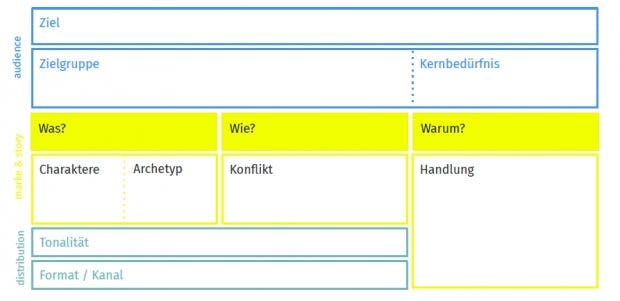
Harnisch uses the storytelling canvas in her agency. The work always begins with the goal setting. This not only applies to overarching meta-goals such as “more traffic for the website”, but is also deepened for each campaign in the most concrete possible goals such as:

  • Deepen customer relationships
  • Deepen the experience of the company or product
  • Gain new clients
  • And many more goals

With the help of this simple template, content marketing can be structured in a targeted manner.

The core of the exercise lies in the following sentence: “For whom do we do what, to achieve what and why?”.

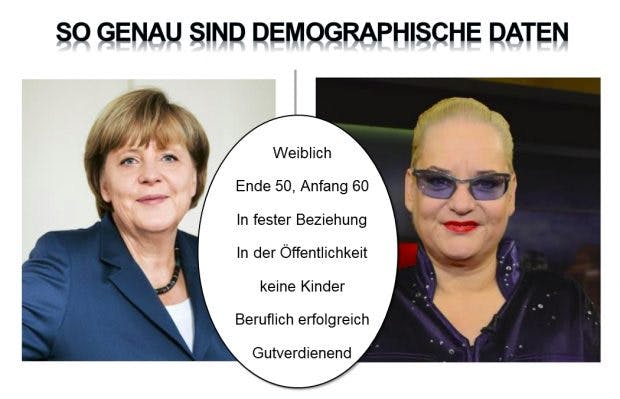
Target groups are more than demographics

The second step is to describe the addressee as precisely as possible. Classic demographic characteristics such as age, gender or place of residence are a start, but fall short in the long run. “In Generation Z we find extremely different types,” says Christian von den Brincken from the marketing giant Ströer. For example, he sees many people with a high need for security in this young target group.

The comparison of Prince Charles and Ozzy Osbourne has already achieved a certain cult status in marketing. Both have very similar demographic characteristics, but are unlikely to be enthusiastic about the same stories.

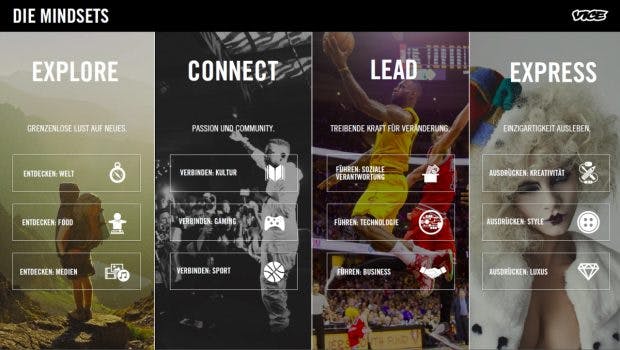
So you have to go deeper when describing the target group. The living environment of the potential addressees can be mapped with personas , for example . This is also a target group description, but more according to types than demographics. Is a person extroverted or not? Is he ready for risk or rather cautious? The persona questionnaire depicts the target group’s environment. Most companies define between five and ten archetypes that they address. The US media company Vice has defined such types for editors so that they know who they are actually writing for.

The media company Vice gives its editors a clear idea of ​​who they are writing for.

Needs, fears, pain points

If you combine the persona description with your own industry or even the product, it quickly becomes clear where there are stories to be told. Just showing problem scenarios creates a direct connection to the target group, for example with a manager who has to travel by train at short notice, but has never booked a ticket himself, because otherwise the secretary would do it. If that were a scenario for content marketing at the railways, one could show that he can relax and buy a ticket from the conductor on the train. It will be more expensive, but – according to the persona description – that is not a problem for him.

How do you get these insights? Content marketing professional Harnisch describes four scenarios:

  1. Questions : Classic market research
  2. Counting : Analytics
  3. Observe : It used to focus on laboratory tests with subjects. This is now also possible via remote software, and specialized online services also provide the software and access to target groups.
    Social media analytics is a mix of counting and observing. The automatic evaluation of comments, ratings and forums can show which problems certain user groups have with an offer or what they find particularly good.
  4. Interpret : This discipline naturally transcends the survey methods mentioned above. However, it also allows external experts who have experience in a specific segment to be called in.

An interesting tool, especially for workshops, is mapping the customer journey . Where does a user take advantage of an offer, where does the need arise, how is his interest sharpened and what may decide the purchase. Not to forget that the journey continues afterwards. Aftersales is often misunderstood as a service function. Today we know that customers like to know beforehand what will happen afterwards. So part of this communication becomes a marketing issue.

An example: If an app says that it is particularly user-friendly and easy to use, this can also be illustrated with the tutorials, which are typically only displayed after download and installation. Why not show the real operation of the software instead of stylized graphics.

The story

Harnisch introduces the so-called Golden Circle here. Once you have found the content of the communication by analyzing the pain points, the question arises as to which means and how to communicate it. So in the middle of the circles is the why, then the how and then the concrete what. It’s not just about the story itself, but also about choosing the right format (video or text) and then choosing the optimal channel for it.

And how do you tell a good story?

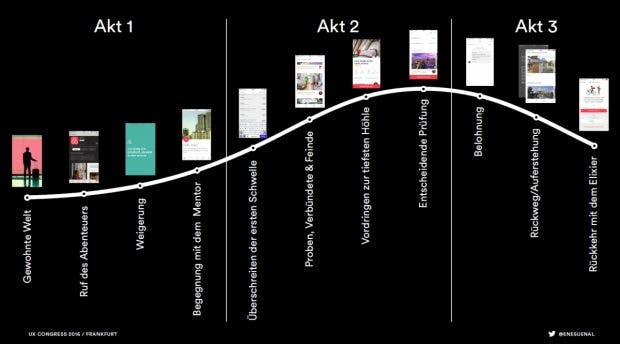
One possible pattern is the hero’s journey. This is a classic concept that is taught at every script school. The hero is initially in his familiar environment, then comes a challenge. At first he refuses, has doubts, but then a mentor appears and advises him. He sets out, has a lot of minor skirmishes and setbacks, until he finally defeats the dragon in the decisive battle and returns home with the “Elixir of Wisdom” and tells his loved ones about it.

The UX expert Enes Ünal removed the Airbnb marketing from the concept of the hero’s journey.

This is how it may sound like at first glance, it is quite simple to transfer to purchasing processes and to fill it with life. Airbnb bases its communication on this model. The “mentor” appears, for example, in the form of reviews from previous customers who advise booking a certain accommodation.

The story construct of the hero’s journey doesn’t just work across an entire customer journey. Even within the individual piece of content, a cognitive dissonance, i.e. a perceived contradiction, is a good introduction to attracting attention. The approach is similar to the hero’s “refusal”.

Susanne Harnisch lists seven archetypal narrative constructs, which in this and similar form almost always make up the backbone of good stories:

  • Overcoming the Monster – Harry Potter
  • From dishwasher to millionaire (Rags to Riches) – Cinderella
  • The Quest – Lord of the Rings
  • Voyage and Return – Alice in Wonderland
  • The comedy, e.g. mix-up (comedy) – some like it hot
  • The Tragedy – Romeo and Juliet, Titanic
  • The Rebirth – The Frog King, Beauty and the Beast

Conclusion

The development of a content strategy based on the content requires more effort at the beginning than writing “from the gut”. However, in permanent operation and especially with changing teams, such a construct proves to be helpful and relieving. And when the core story is in place, people can also be searched for in personnel planning who represent this story and are thus intrinsically motivated and in line with the company’s goals.

New options for advertisers: Facebook allows a more targeted approach

Facebook uses machine learning to enable advertisers to address their target group in a more focused manner. The AI ​​exchanges texts, formats and languages ​​on request.

Facebook knows what works for whom. Why shouldn’t the social media giant use this knowledge to optimize advertising? This is how the extended advertising offer on Facebook can be conceptually described. With three new approaches, Facebook wants to give its advertisers access to this knowledge. The presents the social network in detail in a blog post .

Dynamic advertising formats

In the future, dynamic advertising formats will allow different advertising formats to be displayed according to the respective preferences of the viewer. So if Facebook finds out that a user reacts to advertising in carousel format rather than static overviews, this user will be served accordingly in the future. The advertiser stores different formats, which makes sense. Alternatively, Facebook can generate different formats from given content itself, which may not be optimal.

Text optimization

With text optimization, advertisers store different text content for their advertisements. This can affect the main text, headings and description fields. Facebook then uses the findings from machine learning to show viewers the text combinations that it assumes that they will respond best to.

Translated ads

Last but not least, Facebook now enables advertisers to display their ads in the viewer’s local language. The translation can be done automatically; alternatively, advertisers can also store their own translations. A mixture of automatic translation for most parts of the world and manual translations for the most important target markets will probably make sense here.

The target group for advertisers for the innovations are smaller companies

Experience has shown that large advertisers with budgets in the millions have a wide range of advertising assets and rarely want to hand over control of addressing customers to an artificial intelligence.

Smaller companies, on the other hand, have few resources in terms of financial and human resources and would certainly appreciate machine support for their advertising efforts. Facebook is targeting these companies with its machine learning advertising portfolio.

8 last minute tips for your marketing during the holiday season

Christmas always comes so suddenly. Even if you have not yet prepared your marketing for Christmas business, you can still do something on the last few meters.

It’s back, the busiest time of year. In e-commerce in particular, the Christmas business is an indispensable driver for online retailers, online marketplaces and multichannel providers with online shops and branches. Sales in German e-commerce will grow by double-digit percentages in 2019, up to 70 billion euros  – and the weeks leading up to Christmas will generate a large part of it. So that you can attract customer interest during this time, every wisely spent euro on Christmas marketing is a euro well invested.

Ancient wisdom in marketing: The best time to prepare for the next Christmas business is December 27th. The second best time is now. Sure, you should have tackled extensive strategies that require a lot of preparation in the summer . But even if little has happened in your Christmas marketing so far, you don’t have to do without a successful Christmas business this year. Many customers don’t start looking for festive gifts until December. December 15th is the day on which Germans, on average, spend the most money online.

With a few quick measures you can now polish up your marketing presence for the profitable Christmas business. And many improvements will also help you for the new year. Here are our eight last-minute tips for your Christmas marketing:

Marketing for Christmas – Last Minute

1. Make your appearances Christmassy

Those who put their customers in a Christmas mood can benefit from an increased desire to buy. The customer unconsciously associates the visual link between an offer and Christmas with relevance for his Christmas preparations and purchases. That doesn’t mean that you have to put Christmas arrangements with bells on all your pictures and display banners with fir trees and asterisks. Create Christmas elements that suit your brand and don’t overdo it: the seasonal decorations can quickly appear overloaded.

2. Send your newsletter

At the beginning of Advent, you should make your existing contacts aware of your Christmas offers. It’s also a good place to play discount codes or offer special deals for regular customers. You remember positively.

3. Bring premium offers to the fore

At Christmas, customers are ready to spend larger amounts. Now it is appropriate to put higher priced products and services in the focus of advertising . Show your best merchandise. Even if the customer does not take advantage of this offer, thanks to the mechanisms of price psychology, you still have an increased chance that he will grab your cheaper alternative: The presentation of a high-priced offer has adjusted the customer’s feeling for acceptable amounts so that he sums smaller finds it very cheap.

4. Cords of Christmas boxes

In addition to your standard range, you should offer gift boxes as a set for Christmas: main product, useful supplements, Christmas goodies and high-quality gift packaging. Of course, the boxes are only available for a limited time in the run-up to Christmas.

5. Issue vouchers

Even those who do not work in retail can lure users to their own site with vouchers that are suitable as gifts. Restaurants can score with a dinner, outdoor organizers with an excursion, mobility platforms with free rides. Your own offer is not suitable for vouchers? Enter into collaborations with organizers and service providers that fit your brand.

6. Give advice on gifts

Everywhere there is perplexity: What do I give to my colleague, partner, parents, little ones? Now is the right time to put together gift tips for customers from your offer. They will thank you. Break down the tips according to the interests of the recipient and the personal relationship between the giver and the recipient. Make sure different price levels are served.

7. Make Christmas cards

Fallen out of time? No, Christmas cards you can touch are a classic door opener. They are still a gift that the recipient associates with special appreciation. The Christmas card can be sent to customers or business partners in various ways: Classically by post to a selected group of recipients, enclosed in a gift set, sold in your own shop or personally distributed at events, trade fairs or the local Christmas market.

8. Invest time in social media

Social media is your advertising channel of the hour if you are running late: Posts are planned and created relatively quickly. It doesn’t have to be an elaborate Advent calendar for your fans. It is more important to be present with good storytelling and to awaken emotionally anticipation for the festival. The direct promotional references to the offer only come second.


Online advertising continues to grow by 5 percent and more in Germany

The new “This Year, Next Year” Global Forecast for Group M advertisers predicts advertising spending for 2020 – and predicts that online advertising in Germany will continue to do well.

Overall, global advertising growth is slowing from 5.7 percent in 2018 to 4.8 percent for 2019 and 3.9 percent for 2020 – this is due to the gloomy economic climate worldwide and poorer prospects, especially in some industrialized countries. After all, moderate increases of between three and four percent are expected by 2024.

Online advertising continues with good growth

For Germany, the current Group M report shows one thing above all: digital media is and will remain the strongest driving force in the German advertising market. For 2019, Group M is forecasting growth in digital media spending by six percent, in the following years 2020 and 2021 by five percent each, before an annual growth of between 6 and 9.5 percent is forecast again. Overall, advertising investments in Germany will only rise slightly by 0.9 percent for 2019 and 0.6 percent for 2020, before rates of increase of around two percent are predicted again in the following years.

In addition to the digital market, out-of-home and cinema advertising in particular are proving to be important drivers for German ad spending. This area will grow by 5.7 percent in 2019 and by 3.1 percent in 2020. Linear television, on the other hand, will have to accept falling media budgets in 2019 (-0.5 percent) before a little more money will flow into this channel again in 2020 (+1 percent). For audio formats, growth rates of between one and two percent are possible over the next few years. In contrast, as expected, newspapers continued to suffer the greatest losses, but also magazines to a lesser extent: Group M is forecasting significantly lower advertising investments for both 2019 (-7 percent) and 2020 (-9 percent).

3 steps for a better perspective in the digital TV advertising environment

80 percent of televisions in Germany are now connected to the Internet, and the trend is rising. Reason enough for brands to deal intensively with the new advertising environment.

In addition to traditional TV programs, more and more people are also using digital TV and video offers. Content is increasingly being brought to television via the Internet. Either via Smart TVs or via additional devices connected to the Internet such as game consoles, Apple TV, Google Chromecast or the Amazon Fire TV Stick.

The spread of smart devices opens up new potential for advertisers to effectively reach their target group, because the range of television is supplemented by the digital connection with precision and control. However, in order to find the right channel for their own messages, brands have to be clear about the target group they are dealing with: According to the Viewtime Report 2018 from Sevenone Media, almost half of all connected TV users (CTV users) are between 14 and 39 years old. 36 percent have a monthly net household income of 3,000 euros and thus earn above average. In addition, CTV users are tech-savvy and like to try out new entertainment electronics such as streaming sticks, but also VR glasses or voice assistants. These users have high expectations:

First things first: How do CTV and Addressable TV differ?

These two formats are fundamentally different things. Under CTV, applications are summarized that rely on Internet access and are either installed directly on the television or on peripheral devices such as Apple TV, Amazon Fire TV or game consoles.

Addressable TV (ATV) is also an IP-driven channel, but it provides additional content beyond the linear television program. At the beginning it was mainly content that could be called up by clicking the red button on the remote control and offered the viewer corresponding added value. For example, if a cooking show was on television, viewers could use the red button to call up additional information such as recipes or background information on the program during the program. Quasi a Teletext 2.0.

In the meantime, however, digital overlays in particular have established themselves. For example, if the camera pans into the audience, a banner occasionally appears over the TV picture on addressable TV channels or the program is scaled down and the banner ad surrounds the TV section. The technology used for this in Germany is called HbbTV (Hybrid broadcast broadband TV). In Germany, twelve million addressable TVs are currently available in ten million households (source: Digitization Report, Die Medienanstalten / Kantar TNS, 2018).

While ATV enables new ways of addressing target groups through its placement in linear television programs, CTV in particular offers access to additional viewers who cannot be reached via linear television.

In order to position yourself successfully as a brand in the jungle of the digital TV environment, the following three steps are recommended as a guide:

Step 1: Use the peculiarities of the different channels correctly

With the fundamental technical differences between Connected TV (CTV) and Addressable TV (ATV) in mind, advertisers need to consider which channel is right for them and their target audience. Another crucial difference should be emphasized: CTV, or the individual applications, are controlled by their respective providers, i.e. app providers, for example. With the line item, the ad is shown within the app. If this app offers the user enough incentives to use it for a long time and intensively, this can be an advantage. For example, the app of a video platform offers a wide variety of content that entertains the user for a long time and motivates them to use it continuously.

This works differently with ATV. Here the content is controlled directly by the TV station. As soon as the viewer changes the program, he is offered content from the new TV channel. While here and in classic TV reminder spots, for example, cannot develop their effect, CTV prevents such a break in customer awareness for the advertising offer. Addressing users with a uniform storyline across all channels is fundamentally given at CTV.

The digital offers on television offer an optimal way to reach target groups who have turned their backs on linear television. Among them in particular the younger audience. In addition to classic TV advertising, CTV can also offer precise and controlled target group addressing. Firstly, this type of advertising can be customized. Suitable content can be displayed depending on the interests that are derived from data analysis of the profile of viewers. Second, there is much better control over how often a household watches certain commercials. Incidentally, with some providers also across channels, that is, it can be defined how often a user gets to see a message in total on display, mobile, audio and CTV.

Step 2: Set the right KPIs

In classic TV, the range of the individual station is still the main argument when choosing a channel for advertisements.

But advertisers shouldn’t just rely on reach or rely solely on the number of completed views in digital video channels. When defining the KPI, a cost-related component should always be included in the purchase of airtime and corresponding advertising environments. It is recommended, for example, to optimize for a KPI such as Cost per Completed View (CpCV) – advertisers always have two levers with which the target achievement can be adjusted in the course of a campaign: the number of times a video was viewed in full, and the corresponding cost per impression. The price can be adjusted accordingly on channels that generally have a lower view-through rate (VTR). Even with a smaller VTR, the branding effect is supported by the additional channel at a low price. In the case of attractive channels with a very high VTR, advertisers can then adjust their bid upwards. The increasing coverage of households in the advertising system will very soon open up cross-channel measurement. For example, whether a video spot in the CTV resulted in a user viewing the advertiser’s website on the mobile device.

Step 3: Reach the target group correctly with a feeling for trends

Advertisers should always keep up with the times and keep an eye on which new channels are available for advertising options in order to reach their own target group as best as possible. Some inventories are currently not available in the so-called Open Market, but only via Private Marketplaces (PMP). It is therefore worthwhile for companies to set up such PMPs with a few large marketers, for example to access the inventories of the large premium CTV streaming apps such as Joyn, TV Now, Zattoo, Waipu.TV, Pluto.TV, Samsung TV Plus and Co. to get.

Advertisers should also rely on offers from the Open Market – here, however, it makes sense to keep an active eye on quality and campaign performance.

Conclusion

CTV offers advertisers a way to add data-driven, digital options to the benefits of linear television. Compared to classic TV, CTV offers significantly better targeting, frequency control and better performance measurement. Contrary to the typical German attitude according to the stereotyped thinking “First wait and see how it all develops”, companies should now learn how CTV can best be used.

Marketing trends 2020: from programmatic advertising to moving images

What does the future of online marketing look like? Which trends will accompany us in 2020? It is already clear that some old friends will be picking up speed.

Are there any real trends for online marketing or will everything stay the same as before? We believe that in the coming year, some of the trends that have already emerged in recent years will finally change from hype to practice-relevant topic – and we asked some industry representatives where they see the innovations for next year that are already emerging start today. These five trends will become important in 2020:

The programmatic advertising business is reaching new heights, but is growing more slowly

One of those subjects that is more evolution than revolution is the programmatic advertising business. 65 percent of the expenditure for online advertising worldwide now goes to programmatically controlled advertising formats. The Zenith advertising network is forecasting an increase to 69 percent in 2020 and 72 percent in 2021 – with the US market in particular, but also individual emerging markets, attracting attention with correspondingly high spending. However, the figures also show that it is becoming increasingly difficult for networks to continue to offer the growth rates of recent years. This is due, among other things, to the stricter privacy and GDPR guidelines, which not only play a role in Europe, but increasingly also in the USA.

At the same time, the further shift in advertising budgets towards online- specific forms of advertising – Group M is forecasting a further increase of around 5 percent in online marketing for Germany in 2020 – ensures that performance and measurability are increasingly in the foreground. In other words: what can be measured will be measured more and more precisely in the future, at least by the agencies whose customers require it.

Programmatic advertising is becoming (data-driven) more creative

While the automated advertising business has been one thing above all in recent years, namely predictable, creativity will also play an increasingly important role in the future. Because what the agencies (and even more so the customers!) Often lacked was the creative aspect they used to have. But programmatic advertising is also becoming increasingly creative. And this not only applies in the context of the (more original) communication content, but is also supported by the basic data-driven mechanics of campaigns. Thomas Promny, initiator of D3con , is observing what the organizers say is the largest German specialist conference on the future digital advertising, that the approaches and concepts of campaigns are playing ever more cleverly with the existing technical possibilities: “Technology and setups of programmatic systems enable significantly more – and that is by no means exhausted. The increasing weight of advertisers in the programmatic ecosystem and their growing expertise in programmatic will challenge the agencies’ creativity – and that’s a good thing to finally unleash the full power of programmatic. “

In the USA we have been seeing such types of campaigns and customer dialogue systems for a long time – for example, when a burger chain offers you their burger for an unbeatable price exactly when you want to enter the branch of the direct competitor. Even if the German advertising industry will not act so cheeky and self-confident here, the location-based services offer nice features that are more than just a gimmick for technology-loving advertisers.

And something else is changing: Whereas in the past variables such as “weather” or “time” were the greatest emotions when playing out individualized advertising, we are already seeing campaigns (especially abroad) that work multivariately, i.e. based on location and time Combine variables with weather, situation or certain major events or even implement traffic data. All this data is there, so agencies should use it too. And the more young, tech-savvy decision-makers in the agencies take over the business, the more likely they will do that.

The silo thinking in marketing could now finally be broken open

Numerous tools and services have been competing in parallel in marketing for years. Even if more and more marketing suites, from Adobe to Salesforce, try to cover the different channels (mostly in the context of a marketing cloud), many companies have developed legacy IT in marketing over the years that is difficult to break. The year 2020 could finally bring the breakthrough, because a paradigm shift is now being recognized by younger and online and mobile-centric thinking executives.

The channel through which a certain contact is established is actually irrelevant if the company succeeds in correctly assigning the information to the customer and mapping this accordingly. And more and more companies understand that they can benefit from real-time data and that automated advertising that can be calculated across channels can save the company money. Something else is changing: The cloud is becoming increasingly important because it enables easily scalable solutions that are still accepted in more and more industries, like the established data center.

The fight for the new standards: alternatives to cookie-based advertising

We have been talking about the end of the cookie world for years – originally due to the feared new EU legislation, also known as the e-privacy regulation, which has long hung like a sword of Damocles over the advertising industry and the advertising industry, now mainly but more because of the technical measures taken by the browser manufacturer (namely Firefox and, for a long time, Safari). Because both have severely restricted the use of cookies for the recognition and assignment of users. This applies to both the addressing of users and the assignment of the conversion to a campaign. Although users could adapt the settings for their part in the interests of the advertising industry, experience shows that very few do so.

But what is the alternative to that? It is clear that advertising has to leave its dependency on cookies behind, especially with regard to 3rd party cookies. “Consent-based and therefore legally secure alternative user identifiers (IDs) are already available,” explains Dino Bongartz, CEO of the data management service provider The Adex , and lists: “Tools such as the cookie-free user graph, the same device graph, the cross- Device bridge or the household graph enable successful user identity management even in a multi-ID world. “

However, it will be just as complicated as these alternative concepts to create a communication standard for this proliferation of IDs that enables the data to be used across the board for playing out all formats across all channels and inventories. This interoperability between the systems will probably be the most important challenge as soon as any standards have established themselves.

Social media advertising is becoming more and more diverse

In the past, when it came to social media advertising, it was said: do Facebook, that is sufficient for most requirements, because only the Zuckerberg network allows sufficient data depth and number of cases for individualization in German-speaking countries.
The world is now a little different and, above all, many younger target groups can no longer be found on Facebook. These, in turn, can now be reached – remarkably successfully – via networks such as the short video app Tiktok or the gaming platform Twitch. For example, brands that are not really considered to be youth brands ( Otto and Punica at Tiktok and BMW at Twitch ) can achieve astonishing reach and performance values in their campaigns.

The agency Webguerillas / Territory again tried this for BMW with a campaign for the 2 Series Coupé on Twitch – in an environment that is neither suitable for Facebook nor Instagram: the young, male, technology-loving target group that is difficult to address via classic channels such as Instagram . In principle, the platform is well suited for marketing because users often spend hours there and, above all, interact a lot with others. However, this is not a license for dull marketing campaigns! Marlies Bayha, Executive Creative Director at Territory Webguerillas, who supervised and was responsible for the project, advises caution: “Half-hearted brand communication that is not appropriate for the target group is doomed to a shit storm here. Irrelevant brand messages are not only ignored,

The bottom line is that Facebook in 2020 will be the standard answer for social media campaigns less and less; instead, target group-specific solutions will become more and more important: LinkedIn and possibly Xing for HR and employer branding campaigns, Tiktok for the very young target groups, Twitch for young, especially male tech enthusiasts. But Instagram is also important, especially in B2C marketing. Impressive growth rates are still possible here if the customer knows how to use the network well.

A special situation will arise for Tiktok in 2020: The supposedly so ignorant network of Chinese origin (behind it is the Chinese company Bytedance) will only remain the darling of marketers and the advertising industry if the mood of the young fans (and their parents) does not change . But that is precisely what is to be feared if the company continues to blunder in the direction of discrimination and censorship .

This should also change the business of influencers: in 2020, agencies are asking for numbers even more than before, but they are also asking whether the numbers match the goals of their campaign. One thing is clear: the influencer industry has become more professional in a positive sense in 2019 and will continue to do so.

Infographic: How brands influence our buying decisions

This infographic brings together 32 facts about brand loyalty and how it influences the shopping behavior of many shoppers.

Even if many people don’t want to admit it: brands undoubtedly have a significant influence on our consumer behavior. According to a 2015 Nielsen study, six out of ten consumers prefer buying products made by brands they know.

Brand loyalty does not only have a direct impact when purchasing a product, it can also have positive effects on online marketing. According to a survey of around 4,000 consumers from the USA, Germany and Great Britain, 64 percent of users would only open an email because they trust the brand. In the USA the value was even higher at 70 percent.

Infographic: 32 facts about the influence of brand loyalty on shopping behavior

The service provider Invesp, which specializes in the optimization of conversion rates, has collected a total of 32 facts on the subject of brand loyalty and prepared them in the form of an infographic. If you want to get a quick overview of the influence brands have on purchasing behavior and how brand loyalty differs depending on the market segment and gender, you should take a look at the graphic.

Reward marketing: 5 tips for increasing sales with vouchers

Vouchers are marketing instruments that are used to specifically encourage customers to buy. The five golden rules of professional coupon marketing reveal how the use of vouchers significantly boosts sales.

Limit vouchers

People always want what they cannot have. If you limit a discount offer to a specified number of items, the incentive to buy is increased for interested parties. If you give vouchers a countdown, which shows the customer in which time window to strike, you actively encourage customers to make a purchase decision.

Spread forward-looking offers

Online shops should reward regular customers during a checkout with a voucher that is tied to the next purchase in the shop. In order to offer a special incentive, customers should be shown how much discount the voucher would have brought with the current purchase when they received the voucher. Coupons are much more effective when the discount is in double digits. This suggests to the customer that they have the opportunity for a particularly large bargain.

Include vouchers in competitions or in recommendations from new customers

Vouchers have a great advertising effect and can be ideally integrated into competitions in large numbers. Online shops that offer attractive prizes in a raffle can reward participants who are not among the main winners with unlimited vouchers for their commitment. This contributes to the acquisition of new customers and general customer loyalty. Satisfied customers are the best advertisement . For this reason, it makes sense to give them an incentive to make recommendations within their environment. This succeeds in the case of new customer acquisition with the reward of vouchers.

Increase shopping cart value or waive shipping costs

Practice shows that vouchers that can only be redeemed from a certain minimum order value encourage buyers to order more. Therefore, it makes sense to give coupons a realistic value that buyers are willing to spend in order to receive a voucher. Depending on the product segment, different values ​​and their effect on purchasing behavior should be tested. Another option is to offer free shipping. Customers are happy that they only pay for their product and that they have saved money sensibly.

Guarantee uncomplicated redemption processes

Customers like to receive gifts and feel particularly valued as a result. The joy of redeeming vouchers, however, fades when they find themselves in complex and time-consuming processes that complicate the use of the coupon. The use of codes that automatically reduce the total in the shopping cart is a user-friendly variant in which customers can enjoy the reduced price without any effort.

Online shops have to assert themselves against a mass of competitors every day. If you want to position yourself positively, you should keep new and regular customers happy with discount campaigns. This makes a major contribution to customer care, increases the traffic in the shop and increases sales in a targeted manner.

Google gives tips for podcast SEO

Websites that primarily contain audio offers such as audio books or podcasts face particular challenges when it comes to search engine optimization. Now Google’s search engine guru John Mueller has given important tips.

For search engines, the on-page text of a website is still an important means of being able to grasp the content and to understand which user needs expressed in a search query can satisfy exactly this page. But what if the page content is mostly in audio format? How does Google find me then?

This question also haunted a user on Reddit who asked , “Our website is a PWA and it offers audiobooks, podcasts and audio shows. How can you tell Google to treat us by these standards? Because it could punish us if we have no content on the page. “

The questioner added that the site provides meta description, title and 30 to 50 words of description for the audio content. That this is a progressive web app (PWA), i.e. a website that feels almost like a native app, could have increased his uncertainty about SEO.

Google: Audio offers also need texts

Besides the answers from SEO connoisseurs, there were also tips from John Mueller, webmaster trends analyst at Google and something like the highest authority when it comes to how the Googlebot works. Mueller confirmed that a website needs written content for Google to understand and rank. He wrote:

“You always need textual content on the page, regardless of what other types of content you offer.
If you’re a video hosting site, you still need things like title, headline, text, links, etc. The same goes for audio hosting sites. Make it easy for the search engines to understand your content and its relevance for the users – then they can send you relevant traffic. “

So doing without text altogether is a very unfavorable SEO strategy for podcasts and audio books. There should be enough written references to the content so that search queries can match the offer. As is so often the case, Google equates the Googlebot with the users in its answer: If the user understands it well, the Googlebot will understand it too. Technical details on how this understanding arises are not given. Mueller added again:

“If you make it difficult for search engines to find out what your pages are about, it’s perfectly normal for them to have a hard time figuring out how your website is relevant to users.”

(Photo: t3n)

Podcast from t3n: Special requirements for SEO. (Photo: t3n)

SEO for podcasts and audio books

Other members of the Reddit community provided additional tips for sites with audio content. Together they make a short SEO guide for podcasts:

Transcribe the content

Write down what you say so that the search engine can pick it up. It doesn’t have to be a complete speech-to-text transcription. Frequently used words and phrases can be unsuitable, especially for recorded conversations. The actual keywords, the topic of the conversation, can easily get lost and thus cause a bad ranking. It is better to summarize or to transcribe selected passages with the appropriate keywords.

Structured data for podcasts

A good hint is the use of structured data. Wherever these markups can be added, they should be used. You should make sure that the information that flows into the structured data can also be found on the website. Schema.org shows the possibilities of structured data, for example for podcasts . Google also needs an RSS feed to display the audio content for Google Podcasts, Google Play Music, and other services. The Google guidelines provide detailed information .

Structured data for audio books

Google treats audiobooks a little differently than podcasts – they are classified as books that in turn have their own forms of structured data . Google limits the complete feature for the optimal display of books to large publishers and retailers of books who can present a large selection of book media. If you do not belong to this group, however, you can hope to appear with the audio book under the Rich Results. The more meticulously you can fill out the structured data for audio books, the better. Schema.org provides examples of how each property should be used.